

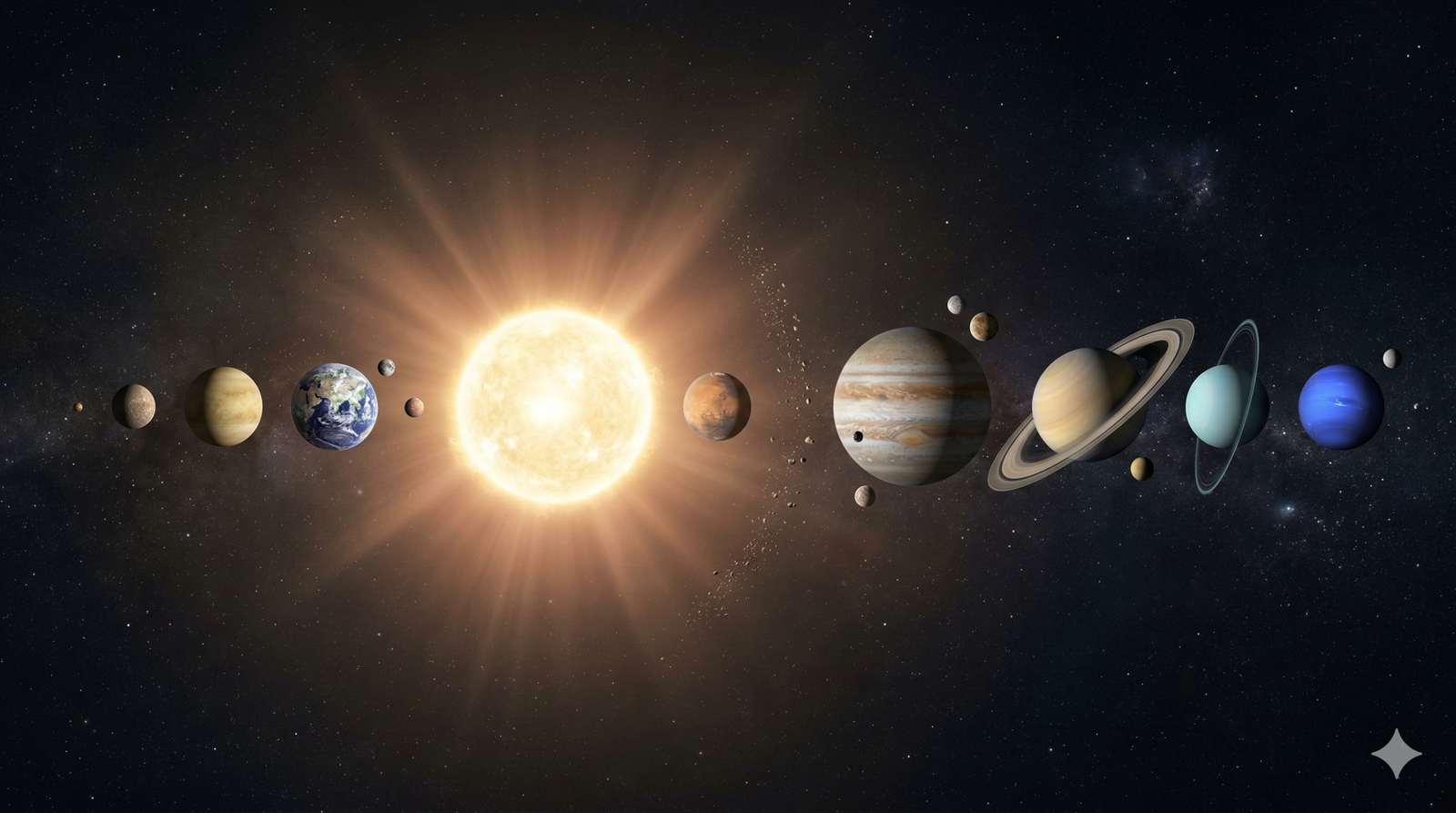
The Solar System is one of the most fascinating places in the universe. It includes the Sun, eight planets, moons, asteroids, comets, and countless smaller objects. Studying it helps us understand how planets, stars, and life itself formed. Here are 10 interesting facts about the Solar System that will amaze you.
1) The Sun Contains 99% Of The Solar System’s Mass
The Sun is the largest object in our Solar System. It holds 99% of the system’s total mass, which means all planets, moons, asteroids, and comets combined make up less than 1%. The Sun’s gravity keeps everything in orbit.
Without the Sun, planets would drift into space. It also provides light, heat, and energy necessary for life on Earth.
2) Mercury Can Have Extreme Temperatures
Mercury, the planet closest to the Sun, experiences extreme temperatures. Daytime temperatures can reach 430°C (800°F), while nighttime temperatures can drop to -180°C (-290°F).
This huge difference happens because Mercury has almost no atmosphere to trap heat. Despite being so close to the Sun, nights on Mercury are freezing cold.
3) Venus Spins Backwards
Venus is often called Earth’s twin because of its similar size. But it rotates in the opposite direction compared to most planets. On Venus, the Sun rises in the west and sets in the east.
One day on Venus (one full rotation) lasts 243 Earth days, which is longer than its year of 225 Earth days!
4) Earth Is The Only Planet With Liquid Water
Earth is the only planet in our Solar System known to have liquid water on its surface, a key ingredient for life. Water covers about 71% of Earth’s surface.
While scientists have found ice and water vapor on other planets and moons, Earth remains unique for having oceans, rivers, and lakes that support diverse life forms.
5) Mars Has The Largest Volcano And Canyon
Mars, the Red Planet, has some extreme landforms. Olympus Mons is the largest volcano in the Solar System, standing 22 km (13.6 miles) high—nearly three times the height of Mount Everest.
Mars also has Valles Marineris, a canyon system more than 4,000 km (2,500 miles) long, which is 10 times longer than the Grand Canyon on Earth.
6) Jupiter Is The Largest Planet And Has A Giant Storm
Jupiter is the biggest planet in the Solar System. It is more than 11 times wider than Earth and has a mass 318 times that of Earth.
One of its most famous features is the Great Red Spot, a giant storm larger than Earth that has been raging for hundreds of years. Jupiter also has 79 known moons, including Ganymede, the largest moon in the Solar System.
7) Saturn Is Famous For Its Rings
Saturn is best known for its beautiful ring system, made of ice, rock, and dust. The rings extend thousands of kilometers, but they are very thin—only about 10 meters thick in some places.
These rings are not permanent. They may change over millions of years as particles collide or drift away. Saturn also has over 80 moons, including Titan, which has lakes of liquid methane.
8) Uranus Rotates On Its Side
Uranus is unique because it rotates almost horizontally. Its axis is tilted about 98 degrees, making it spin on its side like a rolling ball.
This tilt causes extreme seasons. Each pole gets 42 years of sunlight, followed by 42 years of darkness, during its 84-year orbit around the Sun.
9) Neptune Has The Strongest Winds
Neptune is the farthest planet from the Sun. It is known for having the fastest winds in the Solar System, reaching up to 2,100 km/h (1,300 mph).
Despite being far from the Sun and very cold, Neptune has a dynamic atmosphere with storms and clouds that move rapidly across the planet.
10) Pluto Is A Dwarf Planet With A Heart-Shaped Glacier
Pluto, once considered the ninth planet, is now classified as a dwarf planet. It has a thin atmosphere and an icy surface.
One of the most interesting features is Tombaugh Regio, a heart-shaped glacier made of nitrogen ice. Pluto also has five known moons, with Charon being the largest.
Bonus Facts About The Solar System
- Asteroids and comets: The Solar System contains millions of small bodies. Some, like Ceres and Vesta, are in the asteroid belt between Mars and Jupiter. Comets come from the distant Oort Cloud and Kuiper Belt.
- Moons Galore: Jupiter and Saturn alone have dozens of moons, some of which may have oceans under ice. Europa (Jupiter) and Enceladus (Saturn) are top candidates for future life studies.
- Solar wind: The Sun constantly emits a stream of charged particles called solar wind, which affects planets and creates auroras near Earth’s poles.
Why The Solar System Is Amazing
The Solar System is not just a group of planets orbiting the Sun. It is a dynamic and complex system with incredible variety: giant storms, ice moons, volcanic mountains, and dazzling rings.
Learning about it helps us understand:
- How planets form
- How life exists on Earth
- How the universe works
Even though humans have only explored a tiny part, the Solar System continues to surprise scientists with new discoveries.
Final Thoughts
From Mercury’s extreme temperatures to Neptune’s super-fast winds, and Saturn’s rings to Pluto’s icy heart-shaped glacier, the Solar System is full of incredible facts.
Every planet, moon, and asteroid tells a story about how our cosmic neighborhood formed and how it continues to change. Exploring it reminds us of the beauty, mystery, and scale of the universe.
The next time you look at the night sky, remember that our Solar System is not just a collection of rocks and gas—it’s a living, moving, and fascinating place full of surprises.
FAQ Section
1) How many planets are in the Solar System?
There are 8 planets: Mercury, Venus, Earth, Mars, Jupiter, Saturn, Uranus and Neptune.
2) Why is Pluto not a planet?
Pluto is classed as a dwarf planet because it has not cleared other objects from its orbit.
3) Which planet is the biggest?
Jupiter is the biggest planet in the Solar System.
4) Which planet is the hottest?
Venus is the hottest because its thick atmosphere traps heat.
5) Which planet has the fastest winds?
Neptune has the strongest winds in the Solar System.
6) What are Saturn’s rings made of?
Mostly ice and rock particles, from tiny grains to large chunks.
7) Which planet spins on its side?
Uranus rotates on its side because of its extreme tilt.
8) Does any other planet have liquid water like Earth?
Not on the surface like Earth. Some moons may have oceans under ice, but Earth is the only known world with stable surface water.
9) What is the Great Red Spot?
A massive storm on Jupiter that has lasted for hundreds of years.
10) Why does Mercury get so hot and so cold?
Mercury has almost no atmosphere, so it cannot hold heat at night.




Leave a Reply