

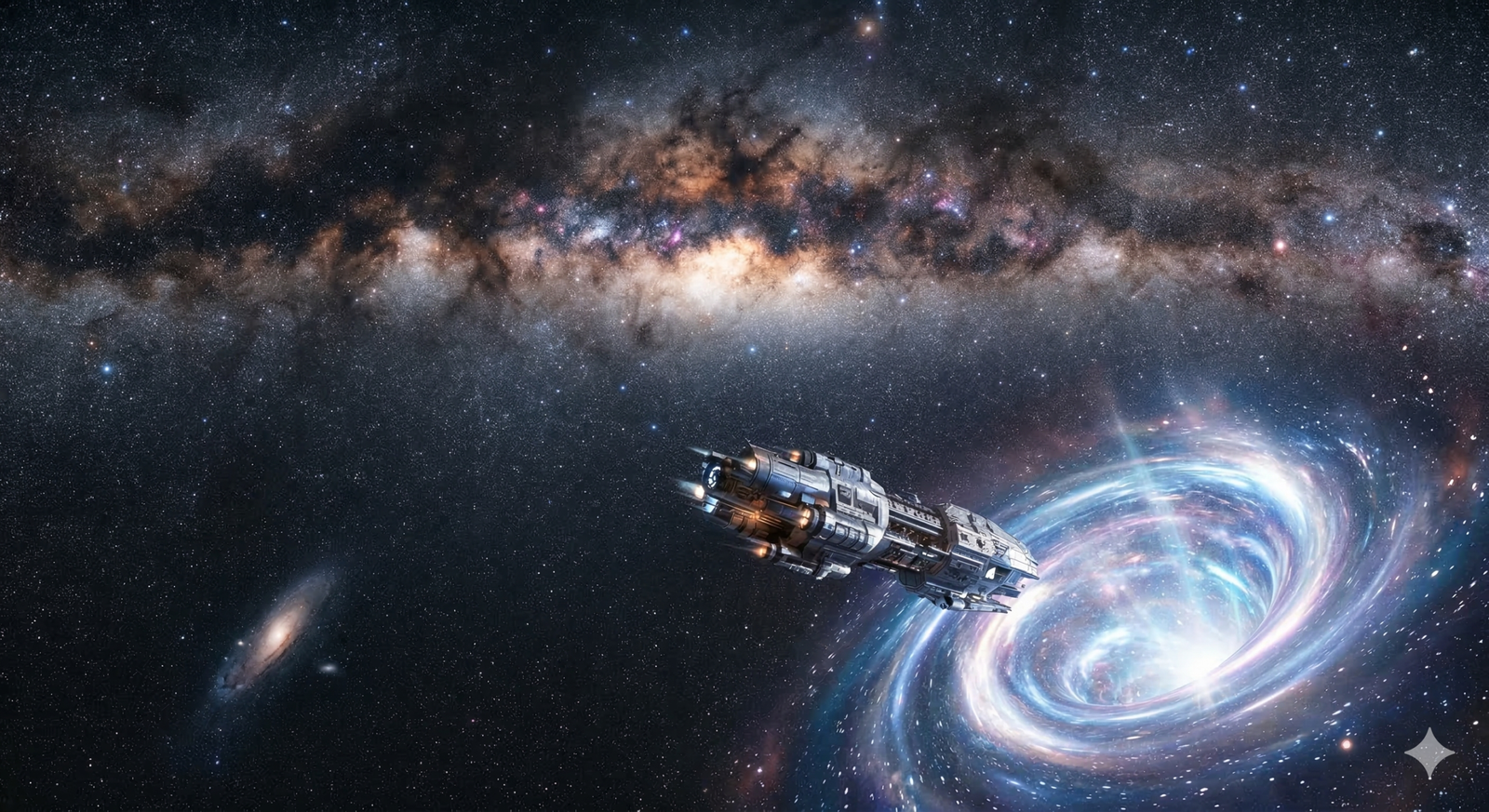
Have you ever looked up at the night sky and wondered what lies beyond our galaxy?
It is a fascinating thought. Our home galaxy, the Milky Way, contains hundreds of billions of stars. Beyond it lie trillions of other galaxies scattered across the universe.
Naturally, a question arises:
Could humans ever travel outside our galaxy?
Science does not completely rule it out. But the challenges are almost unimaginably large. To understand why, we need to explore the scale of the universe, Einstein’s theories, wormholes, black holes, and futuristic propulsion ideas.
Let us begin with the biggest problem of all: distance.
The Enormous Problem of Intergalactic Distance
One of the most shocking facts about space is its sheer size.
The nearest large galaxy to our Milky Way is the Andromeda Galaxy, which is about 2.5 million light-years away.
To understand that number, we must first understand what a light-year means.
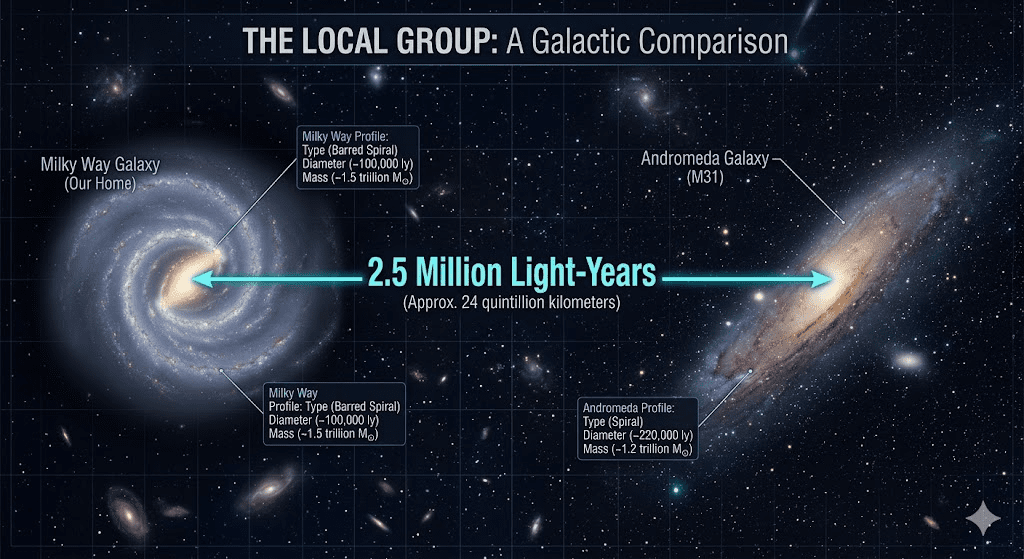
A light-year is the distance light travels in one year. Light moves incredibly fast, at about 300,000 kilometers per second. Even at that speed, it takes years to cross the vast emptiness of space.
Now imagine traveling to Andromeda using our current spacecraft.
Modern spacecraft travel at around 28,000 kilometers per hour. At that speed, reaching Andromeda would take roughly 94.5 billion years.
To put that into perspective:
- The Earth is about 4.5 billion years old
- The entire universe is about 13.8 billion years old
So even with our best current technology, the trip would take many times longer than the age of the universe itself.
Even if we could somehow travel at the speed of light, the journey would still take 2.5 million years.
Clearly, traditional space travel cannot solve this problem. So scientists have explored more exotic possibilities.
One of the most famous ideas is the concept of a wormhole.
Wormholes: Shortcuts Through Space-Time
The idea of wormholes comes from Albert Einstein’s Theory of Relativity.
Einstein discovered that space and time are not separate things. Instead, they form a single fabric called space-time.
Massive objects like stars and planets bend this fabric.
A simple way to imagine this is with a rubber sheet analogy.
If you place a heavy bowling ball on a stretched rubber sheet, the sheet bends downward. Smaller objects rolling nearby will move toward the ball because the surface is curved.
In the universe, massive objects bend space-time in a similar way.
Einstein’s field equations describe how this bending happens.
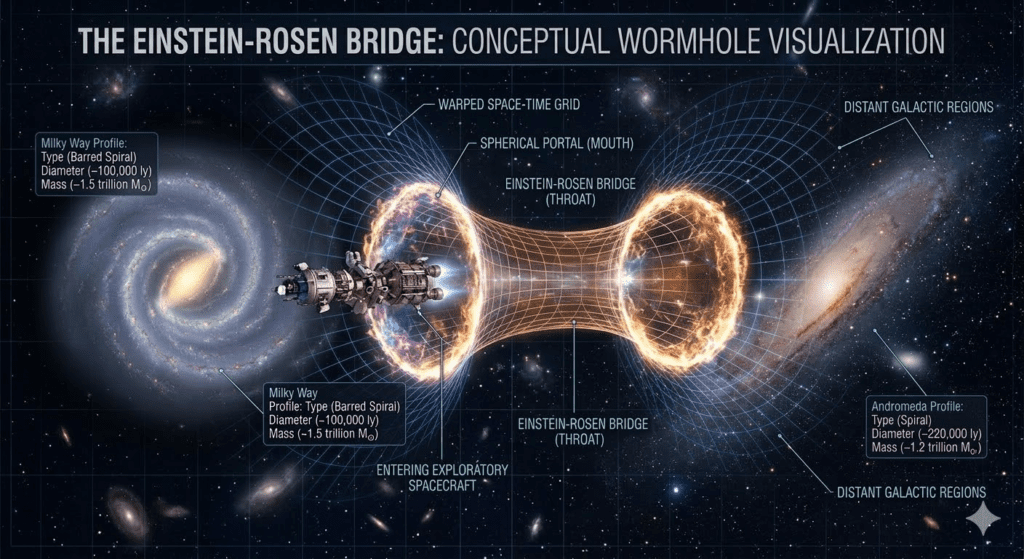
Interestingly, these equations also allow strange solutions known as Einstein-Rosen bridges, which we commonly call wormholes.
What Exactly Is a Wormhole?
A wormhole is essentially a tunnel through space-time connecting two distant points.
Imagine drawing two dots on a piece of paper. Normally, the shortest path between them is a straight line across the page.
But if you fold the paper so the dots touch, you can pass through the paper and instantly reach the other side.
That shortcut is similar to how a wormhole would work.
Instead of traveling across millions of light-years, a spaceship could theoretically enter one side of a wormhole and exit somewhere else in the universe almost instantly.
This concept is often shown in science fiction movies.
However, real wormholes would likely look very different from the swirling tunnels shown in films.
In reality, a wormhole entrance might appear more like a spherical region in space rather than a flat portal.
Could Wormholes Also Allow Time Travel?
Because wormholes create shortcuts faster than light could normally travel, they could theoretically allow time travel.
If one end of a wormhole experienced time differently than the other, someone passing through it might arrive in the past or future relative to where they started.
This idea fascinates physicists but also creates complex paradoxes.
For example:
- Could someone travel back and change history?
- Could events create logical contradictions?
These questions remain topics of deep theoretical research.
The Role of Black Holes
Creating or maintaining a wormhole would likely require enormous gravitational forces.
One place where gravity becomes extremely powerful is inside a black hole.
Black holes form when massive stars collapse under their own gravity. Their gravitational pull becomes so strong that not even light can escape.
Some physicists believe wormholes might be connected to black holes.
But this introduces a serious problem.
If both ends of the wormhole were black holes, anything entering the tunnel would be trapped forever.
There would be no exit.
So how could something escape?
This is where another theoretical object enters the discussion: the white hole.
White Holes: Theoretical Opposites of Black Holes
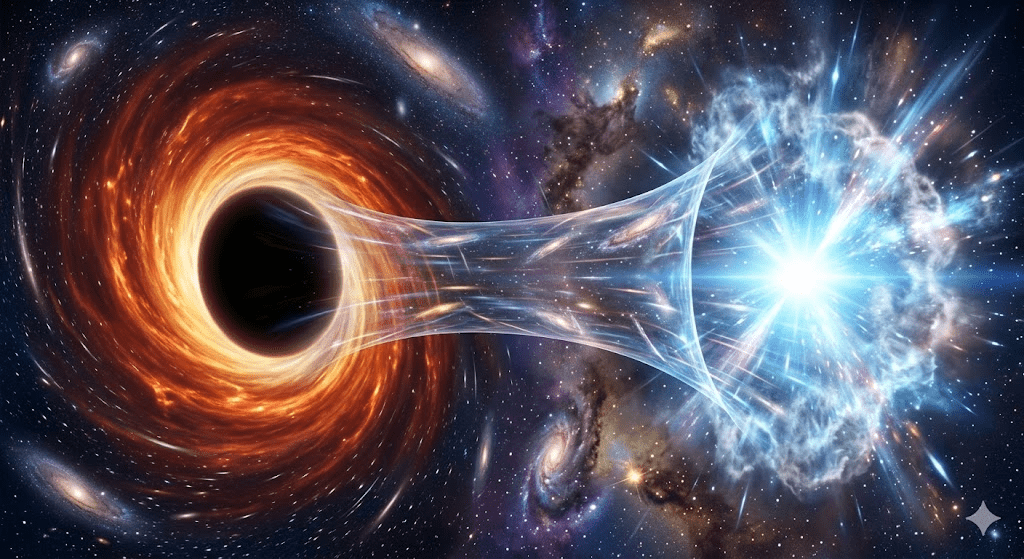
A white hole is essentially the reverse of a black hole.
In a black hole:
- Matter and light can enter
- Nothing can escape
In a white hole:
- Matter and light can escape
- Nothing can enter
You can imagine it as a cosmic fountain that constantly ejects matter into the universe.
According to some theories, a wormhole might connect a black hole to a white hole.
In that scenario:
- A spaceship enters the wormhole through the black hole
- It exits somewhere else through a white hole
However, there is one major problem.
White holes have never been directly observed.
They exist only as mathematical predictions from Einstein’s equations.
Possible Clues From Space Explosions
Some astronomers believe certain mysterious cosmic explosions might be related to white holes.
One example is an unusual gamma-ray burst detected in 2006, known as GRB 060614.
This event did not behave like typical gamma-ray bursts produced by collapsing stars.
Some scientists proposed that it might have been evidence of a white hole releasing matter.
However, this interpretation is still debated, and no definitive proof of white holes exists yet.
Experiments With Magnetic Wormholes
While gravitational wormholes remain theoretical, scientists have managed to create something similar in the laboratory.
Researchers built a magnetic wormhole using special materials.
These materials included a superconducting compound called Yttrium Barium Copper Oxide.
The experiment allowed magnetic fields to travel through a hidden tunnel between two points.
To an outside observer, the magnetic field appeared to disappear in one place and reappear somewhere else.
Although this is not a wormhole capable of transporting objects or spacecraft, it demonstrates that the concept of field tunneling through space is possible.
Another Idea: The Alcubierre Warp Drive
Another theoretical concept for faster-than-light travel is the Alcubierre Drive.
Proposed by physicist Miguel Alcubierre in 1994, the idea suggests that a spacecraft could travel faster than light without breaking Einstein’s laws.
Instead of moving through space faster than light, the ship would warp space itself.
The drive would:
- Compress space in front of the spacecraft
- Expand space behind it
This creates a bubble of warped space-time that carries the ship forward.
Inside the bubble, the ship would remain stationary relative to its surroundings.
In theory, this could allow faster-than-light travel without violating relativity.
However, the energy required might be enormous, possibly equivalent to the mass-energy of entire planets.
So Can Humans Leave Our Galaxy?
At the moment, the honest answer is no.
The distances between galaxies are simply too vast for our current technology.
However, physics does not completely forbid it.
Future breakthroughs in areas such as:
- Wormholes
- Warp drives
- Exotic matter
- Advanced propulsion
could potentially make intergalactic travel possible one day.
But these technologies remain deeply theoretical.
Final Thoughts
The universe is far larger and stranger than we once imagined.
While traveling to another galaxy like Andromeda may seem impossible today, scientific curiosity continues to push boundaries.
Ideas such as wormholes, white holes, and warp drives remind us that our understanding of the cosmos is still evolving.
For now, intergalactic travel remains a dream.
But throughout history, many things once thought impossible eventually became reality.
Perhaps one day, future explorers will look back at our time and smile at how small our technological steps once were compared to the vast universe waiting beyond our galaxy.




Leave a Reply