

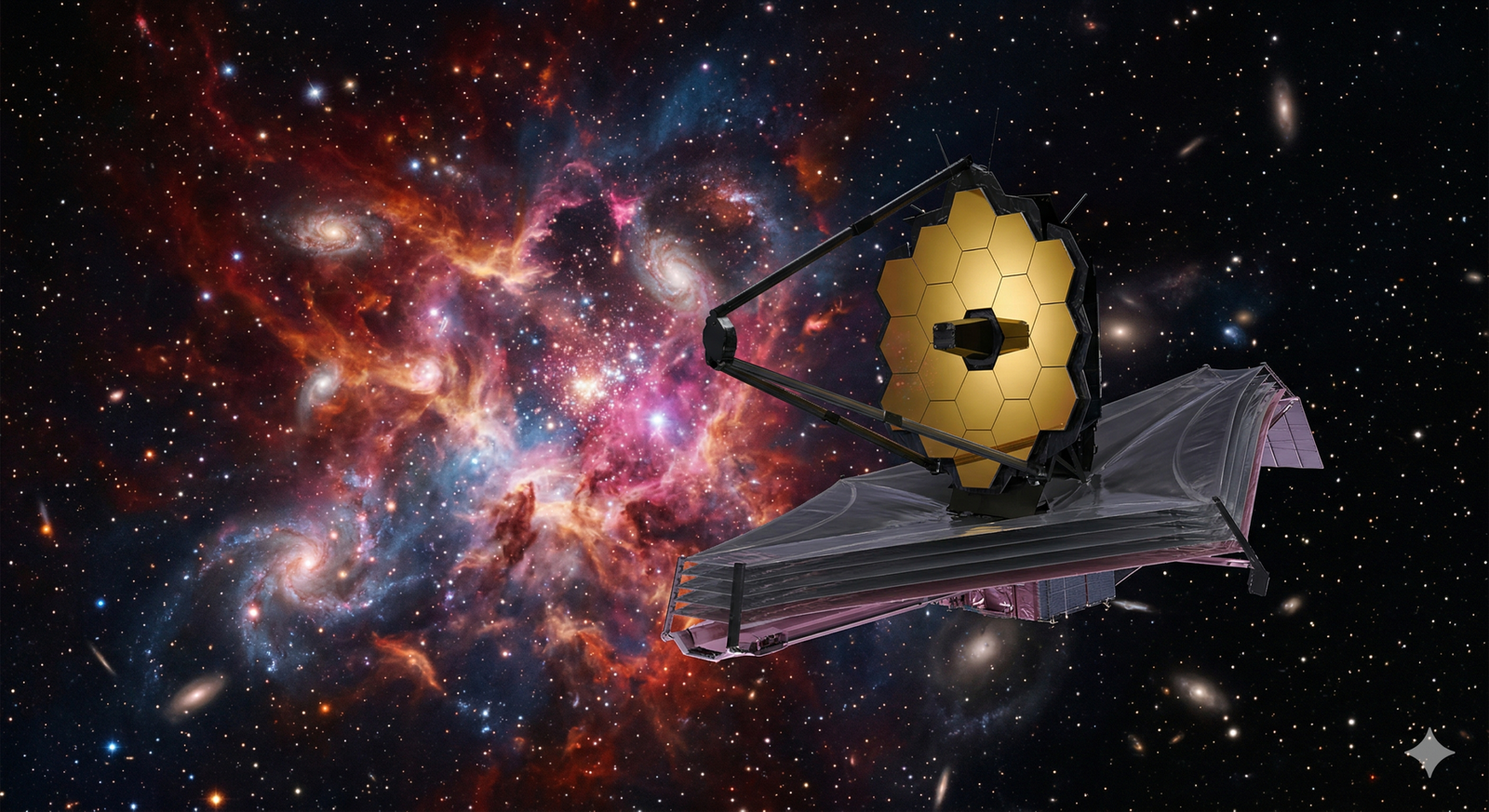
The universe holds many mysteries, and we are just starting to discover them. The James Webb Space Telescope (JWST) is giving us a new view of the cosmos. Since it launched in December 2021, JWST has provided exciting new information about the universe’s history. In this article, we’ll explore what we’ve learned about the early universe and how JWST is changing our understanding of space.
What is the James Webb Space Telescope?
The James Webb Space Telescope was built by NASA, the European Space Agency (ESA), and the Canadian Space Agency (CSA). It is the most powerful space telescope so far, made to look deeper into space and further back in time than any previous telescope, including the well-known Hubble Space Telescope.
JWST is different because it observes space using infrared light, while Hubble uses visible and ultraviolet light. Infrared light can pass through cosmic dust, allowing JWST to see things that were hidden before. This helps scientists study faraway galaxies, stars, and even the early moments of the universe.
How Does the James Webb Space Telescope Work?
JWST has a large mirror that is 6.5 meters wide, much bigger than Hubble’s 2.4-meter mirror. This larger mirror lets JWST collect more light, so it can see very faint and distant objects.
A key feature of JWST is its infrared cameras. These cameras let it see light that has been stretched by the universe’s expansion, a process called “redshift.” By studying redshift, JWST can look back to the first moments after the Big Bang and help us learn about the universe’s early days.
What Have We Learned About the Early Universe?
JWST’s main goal is to study the early universe and what happened soon after the Big Bang, around 13.8 billion years ago. Here are some of its most important discoveries so far:
1. Finding the First Galaxies
One exciting thing JWST is doing is helping scientists find the first galaxies that ever formed. These galaxies are very far away, so their light takes a long time to reach us. Looking at them is like looking back in time. Because JWST can see infrared light, it can detect these faint, early galaxies that were too dim to see before.
These galaxies formed only a few hundred million years after the Big Bang. By studying them, scientists can learn how galaxies started to form and change over time.
Hubble vs. James Webb: The New Space Era
Before JWST, Hubble was the main telescope for exploring space. But Hubble could only see visible and ultraviolet light, so it could not look through thick dust or find the faintest galaxies. JWST uses infrared light to see through dust and observe galaxies and stars in greater detail. This is a big advance for space exploration.
2. Understanding the Birth of Stars
JWST is also helping us learn how stars are born. In the early universe, huge clouds of gas and dust came together to form the first stars. JWST can look deep inside these clouds and show us how stars form. This is something we are just starting to understand, and JWST’s findings are helping answer questions like how stars form, what the first stars looked like, and how they affected their surroundings.
JWST’s infrared technology lets us see how stars were born in the early universe, giving us a special look at this cosmic process.
3. Searching for Exoplanets and Signs of Life
JWST is also studying exoplanets, which are planets that orbit stars outside our solar system. These planets are very hard to study, but JWST’s advanced tools can examine their atmospheres to find out what they are made of. By looking at these atmospheres, scientists can search for signs that might suggest life.
JWST can detect gases like water vapor, carbon dioxide, and methane in exoplanet atmospheres. This helps us learn more about the chances for life beyond Earth.
4. Mapping the Cosmic Web
The “cosmic web” is a huge structure in the universe, made of galaxy clusters linked by empty space. JWST is helping scientists study this web in more detail than ever before. By looking at these large structures, we can learn how galaxies and matter spread out after the Big Bang and how the universe took its current shape.
JWST’s studies of the cosmic web are giving us new ideas about how galaxies and other cosmic structures formed over time.
Why Is JWST’s Research So Important?
The research JWST is doing is not just interesting; it is important for several reasons:
- It expands our knowledge of the universe. JWST is helping scientists answer some of the biggest questions about where the universe came from and how it has changed.
- It pushes the boundaries of space exploration. Thanks to its powerful instruments, JWST lets us see farther and deeper into space than ever before.
- It impacts other fields. The technology created for JWST is now used in other areas of science, like medicine and climate research. This shows how space exploration can help life on Earth.
What’s Next for JWST?
As JWST keeps working, we can look forward to even more important discoveries. The telescope is still early in its mission, and as it observes more of the universe, it will help us learn about how galaxies form and whether life might exist on other planets.
Every time JWST makes a new observation, it helps solve mysteries that could change how we see our place in the universe. The future of space exploration is promising, and JWST is at the front of this progress.
Conclusion
The James Webb Space Telescope is already changing how we understand the universe. It has helped us find ancient galaxies, study how stars are born, and search for signs of life on faraway planets. As JWST continues its mission, it will keep uncovering new secrets about the cosmos and our place in it.
FAQs
1. How far can the James Webb Space Telescope see?
JWST can look about 13.5 billion years into the past, almost to the very beginning of the universe.
2. How is JWST different from Hubble?
While Hubble looks at visible and ultraviolet light, JWST observes infrared light, allowing it to see through dust and study distant objects in more detail.
3. Can JWST find life on other planets?
JWST is studying the atmospheres of exoplanets, looking for gases like water and carbon dioxide, which could indicate the potential for life.
4. What is the cosmic web, and how is JWST helping us understand it?
The cosmic web is a vast structure made of galaxy clusters connected by empty space. JWST’s observations are helping scientists understand how these structures formed and evolved over time.
5. Will JWST discover dark matter?
JWST is not specifically designed to study dark matter, but its observations of galaxy clusters and large-scale structures could provide valuable clues about this mysterious substance.




Leave a Reply